
Tarot de Marseille quiz: history and imagery
A quiz on the Tarot de Marseille: woodcuts and stencils, Conver and Noblet, the nameless arcanum, the House of God and the Popess. Test your deck history.
- 5 questions
- ≈ 2 min
- +5 bronze keys for a flawless run
What is the Tarot de Marseille?
This quiz tests what you know about the Tarot de Marseille, the French pattern that stayed the standard tarot of Europe for three centuries. It was printed from carved wooden blocks and colored through stencils, which gives it bright flat tones and a strong black outline. Its number cards show only the suit symbols, with no scenes.
The name is misleading. Decks of this pattern were made in Paris, Lyon, Marseille and other towns in France and Switzerland. One of the early surviving examples is the deck of the Paris card maker Jean Noblet from the mid-1600s, and the most copied was made by Nicolas Conver of Marseille in 1760. The label Tarot de Marseille itself only became common in the twentieth century.
How are the Marseille arcana different?
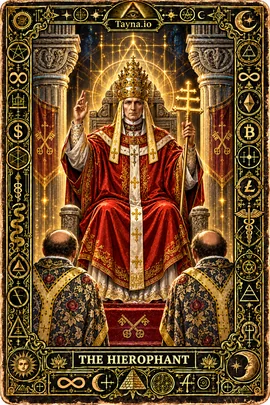
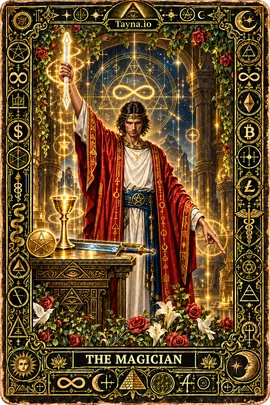
If you learned on a modern deck, many Marseille cards will surprise you. The Magician here is Le Bateleur, a fairground conjurer behind a table of objects. The High Priestess is the Popess, the Hierophant is the Pope and the Tower is the House of God. On the Lover card a young man stands between two women while Cupid takes aim above.
In many decks card XIII carries no title at all and is known as the nameless arcanum. The Fool, Le Mat, has no number, and each suit has a Valet instead of a Page. None of this is whimsy: it is the trace of the game tarot grew out of and of how differently each workshop drew it.
How the quiz works
Each run draws five random questions from a pool of twelve: printing technique, card makers, card names and their pictures, plus true-or-myth statements. After every answer you see an explanation, and the run ends with a full review. A run without a single mistake earns Tayna keys.
The Marseille deck is worth knowing even if you read with another one. Many images that feel timeless are actually late, and many old meanings still live in the cards. Tayna reads cards by their classic meanings, and knowing their roots helps you understand why they sound the way they do.
All questions and answers
Open after you play: the full question set with right answers and explanations.
1. How was the classic Tarot de Marseille printed?
Right answer: Woodcut and stencil
The outline was printed from a wooden block and the colors added through stencils, hence the flat bright tones.
2. Which arcanum is often left untitled in the Tarot de Marseille?
Right answer: Death
Card XIII was often printed with no title, so it is known as the nameless arcanum.
3. What is the Tower called in the French Tarot de Marseille?
Right answer: The House of God
La Maison Dieu, the House of God. Fire strikes it from the sky and two figures fall.
4. The Tarot de Marseille was printed only in Marseille.
Right answer: Myth
Decks of this pattern came from Paris, Lyon and other towns. The name only stuck in the 20th century.
5. How is the Magician shown in the Tarot de Marseille?
Right answer: As a fairground conjurer
He is Le Bateleur, a street conjurer at a table of objects. Occultists later turned him into a sage.
6. Whose deck from 1760 became the most copied model?
Right answer: Nicolas Conver's
The deck of Nicolas Conver of Marseille was reprinted more than any other, well into the 20th century.
7. What does the Lover card show in the Tarot de Marseille?
Right answer: A youth between two women
A scene of choice: a youth between two women, with Cupid aiming above. The angel over a couple is 20th century.
8. The number cards of the Tarot de Marseille show story scenes.
Right answer: Myth
They show only suit symbols in a pattern, such as five cups on the Five of Cups. Scenes came later.
9. What is the High Priestess called in the Tarot de Marseille?
Right answer: The Popess
La Papesse, the Popess. The name High Priestess came from the English occult tradition.
10. In which centuries did the Marseille design take shape?
Right answer: 17th to 18th
The design settled in France in the 1600s and 1700s, though its roots go back to Italian decks.
11. You draw a Marseille Eight of Cups: eight cups, no scene. How do you read it?
Right answer: By number and suit
Without a scene you read the suit and the number: Cups are feelings, eight is moving on.
12. In the Tarot de Marseille the Fool is numbered 0.
Right answer: Myth
Le Mat carries no number in Marseille decks. The zero came later, in occult and English decks.