Fives in Tarot: The Four Cards of Disruption
In tarot, a five marks the moment stability breaks: rivalry, loss, scarcity or a bitter argument. It is a hard turn rather than an ending — the stage that pushes you to rebuild.
The four fives by suit
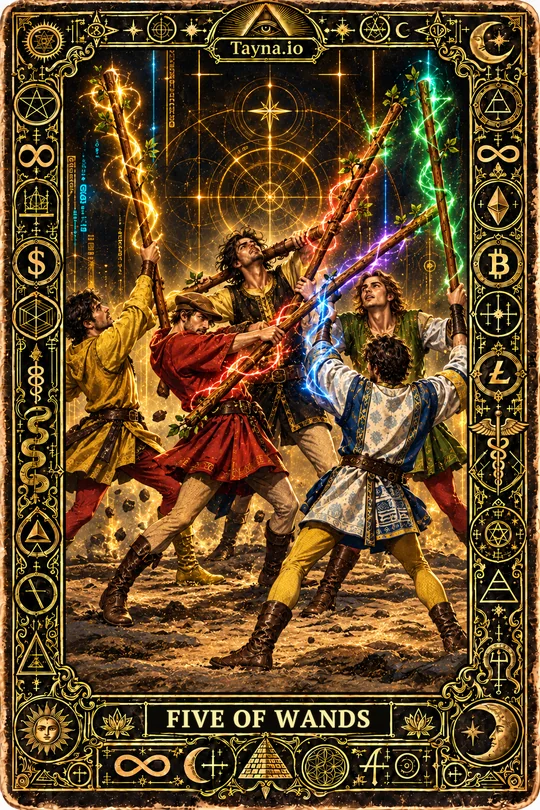
Five of Wands
The Five of Wands is disruption as friction: many voices, many egos, everyone pushing to be heard. Unlike the other fives, nobody has really lost anything yet — it is a noisy contest that can even sharpen your skills. The card asks you to decide what rules the game should have.
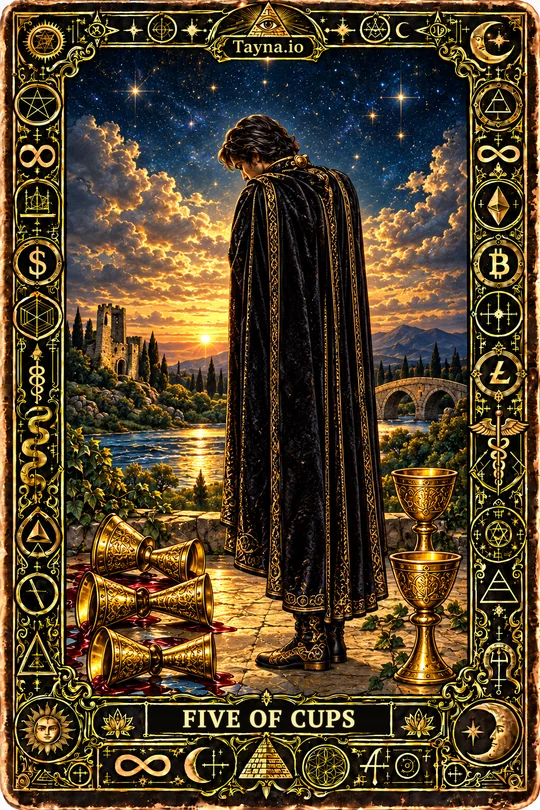
Five of Cups
The Five of Cups is disruption as disappointment. Where the Wands argue and the Swords fight, this figure simply stands still and mourns what spilled. The quiet message is that two cups remain upright behind them, and turning around is a choice anyone can make.
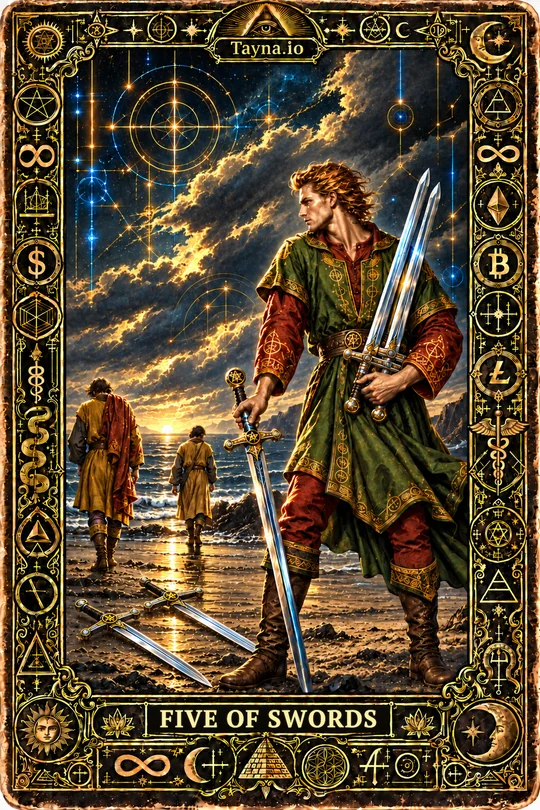
Five of Swords
The Five of Swords is the sharpest five: a clash of words or ideas where winning costs more than it gives. Someone takes the argument but loses trust, or walks away feeling humiliated. It asks whether being right is worth what gets broken along the way.
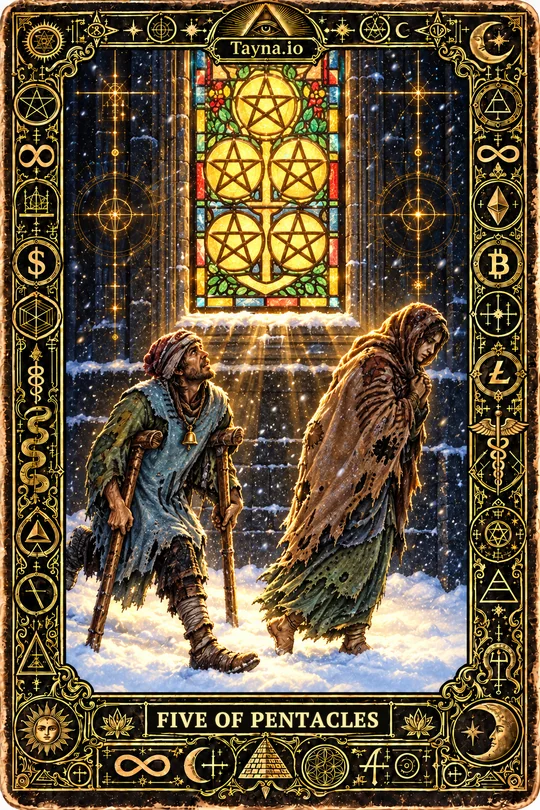
Five of Pentacles
The Five of Pentacles is disruption in the material world — tight money, low energy, the feeling of being left outside in the cold. Its pain is about security rather than feelings. Help is often close by, but it goes unnoticed or feels too awkward to ask for.


What the number five means in tarot
In the numerology of the Minor Arcana, five sits halfway between the Ace and the Ten. The Four built walls, savings and routine, and the story could have stayed there forever. The Five refuses to let it. Something happens that shakes the ground, which is why it is called the number of conflict. A better word might be friction: the pressure that keeps a suit from settling into comfortable stillness.
Five is also the number of the human being — two arms, two legs, a head, five senses. In a reading, that makes the crisis of a five personal and physical. You feel it in your nerves and your schedule, not in theory. The card points to the exact place where things feel tight or sore, and so it points to the place that wants change. It describes a hard stretch, not a permanent state.
How the four fives differ
All four fives describe lost balance, but each hurts in a different place. Wands bring friction and competition — loud, yet rarely damaging. Cups bring sadness over what is gone and attention stuck in the past. Swords bring sharp conflict, where someone feels defeated or ashamed. Pentacles bring scarcity of money, warmth or support, and the sense of standing outside while everyone else is indoors.
Your question helps you tell them apart. In a work reading, the Five of Wands usually means rivalry within the team, while the Five of Pentacles points to a cut budget or worry about income. In love, the Five of Cups suggests disappointment, and the Five of Swords describes a fight that left a bitter taste. When unsure, read the neighbouring cards — they show what kind of disruption this is.
Several fives in one reading
Two fives side by side mean the disruption has spread to two areas that now feed each other. The Five of Pentacles with the Five of Cups is money stress that colours your mood and your relationships. The Five of Wands with the Five of Swords is a work disagreement turning personal, where discussion becomes a contest over who is in charge. A pair like this calls for a pause, not more fuel.
Three fives describe a season rather than an episode. Change has probably been due for a while, the decision kept getting postponed, and now life is nudging things along on its own. This is a time to lighten your load, drop commitments you no longer believe in and look honestly at which supports have stopped holding. The less you resist, the shorter the stretch.
All four fives together are rare and read as a major shift in how you live. The old arrangement has stopped working everywhere at once — in plans, feelings, thinking and money. That sounds alarming, yet in hindsight it often feels like relief: when everything wobbles together, it is easier to design something new as a whole than to keep patching holes one at a time.
Fives in combination with other cards
Next to the Major Arcana, a five shows the larger process behind small troubles. The Five of Pentacles with the Tower is a sudden loss of a familiar support that clears space for a more honest setup. The Five of Cups with the Star is sadness with hope already showing through. The Five of Swords with Justice says the dispute should be settled fairly, by the rules, not by cunning.
Other ranks sharpen the picture too. The Five of Wands with the Knight of Wands points to a hot-headed participant who keeps adding fuel. The Five of Cups with the Six of Cups is longing for a past that seemed simpler. The Five of Pentacles with the Six of Pentacles is hardship followed by help or a generous gesture. The Five of Swords with the Ace of Swords is a truth that can end a long argument in one stroke.
Reversed fives
A reversed five most often means the hardest part is over or about to end. The argument quietens, the sadness loosens, money slowly comes back, the conflict finds a way out. The relief is not instant; it is a turning point where you start seeing what you can do instead of only living through what happened. Many readers count reversed fives among the most hopeful cards in the deck.
There is a second reading as well: the crisis is not solved, only hidden. A reversed Five of Swords can mean a silent grudge, a reversed Five of Wands a rivalry pushed under the rug, a reversed Five of Cups sadness you have not allowed yourself to feel. The surrounding cards tell the two apart — calm, bright neighbours suggest recovery, uneasy ones suggest it is time to open the topic.
Frequently asked questions
Is a five always a bad card in tarot?
No. A five marks a difficult stretch, not the outcome — every suit follows it with a six that brings relief. Think of it as a signal to change, not a punishment.
Which five is the hardest card?
Most readers find the Five of Swords and the Five of Pentacles the heaviest, because they touch self-worth and security. The Five of Wands is the lightest — more noisy contest than real loss.
What do two fives in a reading mean?
Two fives show disruption in two areas at once, with one pulling the other along. Find where the tension started and deal with that first.
Is a five a yes or a no?
A five rarely gives a clean yes. It says the path runs through difficulty, and the result depends on whether you can negotiate, let go of something or ask for help.
Is a reversed five a good sign?
Often, yes — a reversed five commonly marks the end of a hard period. With tense cards around it, though, it can point to a hidden conflict worth talking through calmly.
Which card will you draw today?